
When I talk about leadership I’m really talking about influence through behaviour of a person on another person either consciously or unconsciously (you can be a leader and not even know about it). To get a very, very basic understanding of how influence works we need to understand how we detect it and how we project it.
One thing I want to point out quickly for you to learn and become a better leader is to not dwell in the background and science of leadership. This is not because it’s not interesting it’s just a complete rabbit hole that you can disappear into which is complicated, nearly impossible to remember and certainly not relevant or practical to most people’s lives. Therefore get the basics and remember them when you are operating or give up your job become a behavioural scientist or a brain surgeon and finally be fulfilled.
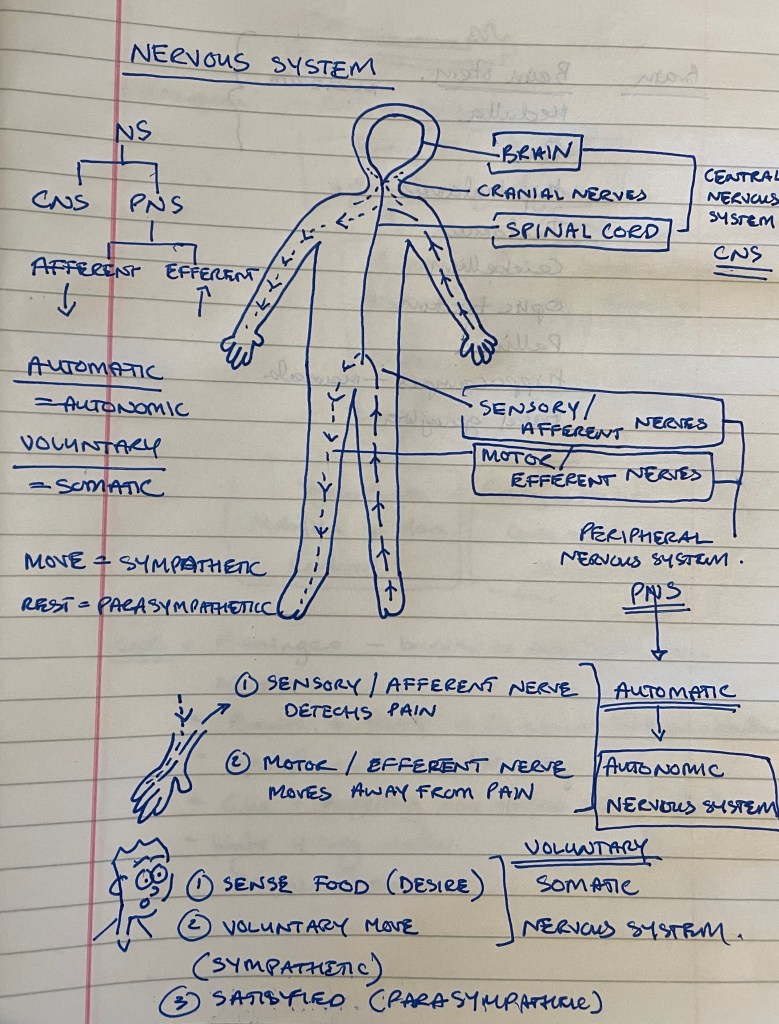
Nervous System – all the nerves
1. Nervous system – defines all the bits that make up how we control our actions and reactions in the environment. The nervous system is made of of several specialist cells with neurones doing the message passing and others supporting their function. Fun fact neurones are the longest cells in the body running from the tip of the toes to the base of the spine.
The nervous system breaks into …
Central Nervous System (CNS) – Brain and Spinal Column
2. Central Nervous System – the protected part of the nervous system consisting of the brain and the spinal cord. The brain controls and regulates the body. The spinal cord passes and takes messages from the body to the brain and back again. CNS is protected physical by bone (skull and spinal column or vertebrae) and chemically through blood filtration into cerebral spinal fluid (CSF) as the CNS is super sensitive to changes in conductivity. Think of it like getting water into your phone.
I’ll come back to the brain to explain how emotions are created and transmitted from the body to the brain and back again.
Peripheral Nervous System (PNS) – Sensing and Moving
3. Peripheral nervous system – the nerves on the outside hence periphery. These are all the ones not in the brain and spinal column so those that move your muscles and control those lovely secreting organs. Muscles contract to move big things around including your body (striated muscle aka the guns), your blood (cardiac muscle), and your food through you (smooth muscle aka gut). Another fun fact both the muscle that contracts your iris and controls poo coming out it smooth muscle – contacts in a ring when you get scared both of these relax allowing you to see better but might need new clothes (this won’t be a priority if it does occur).
The peripheral nervous system can be broken into how messages are passed to the central nervous system. These can be divided into sensing or afferent nerves that detect stuff and then motor or efferent nerves that move things towards or away from things. The message all go from the sensing nerve to the spinal cord where it goes up to the brain for processesing. The message can also go straight back down the motor nerve without the brain knowing about is via a reflex arc that goes up the afferent through the spinal cord and straight back down the efferent.
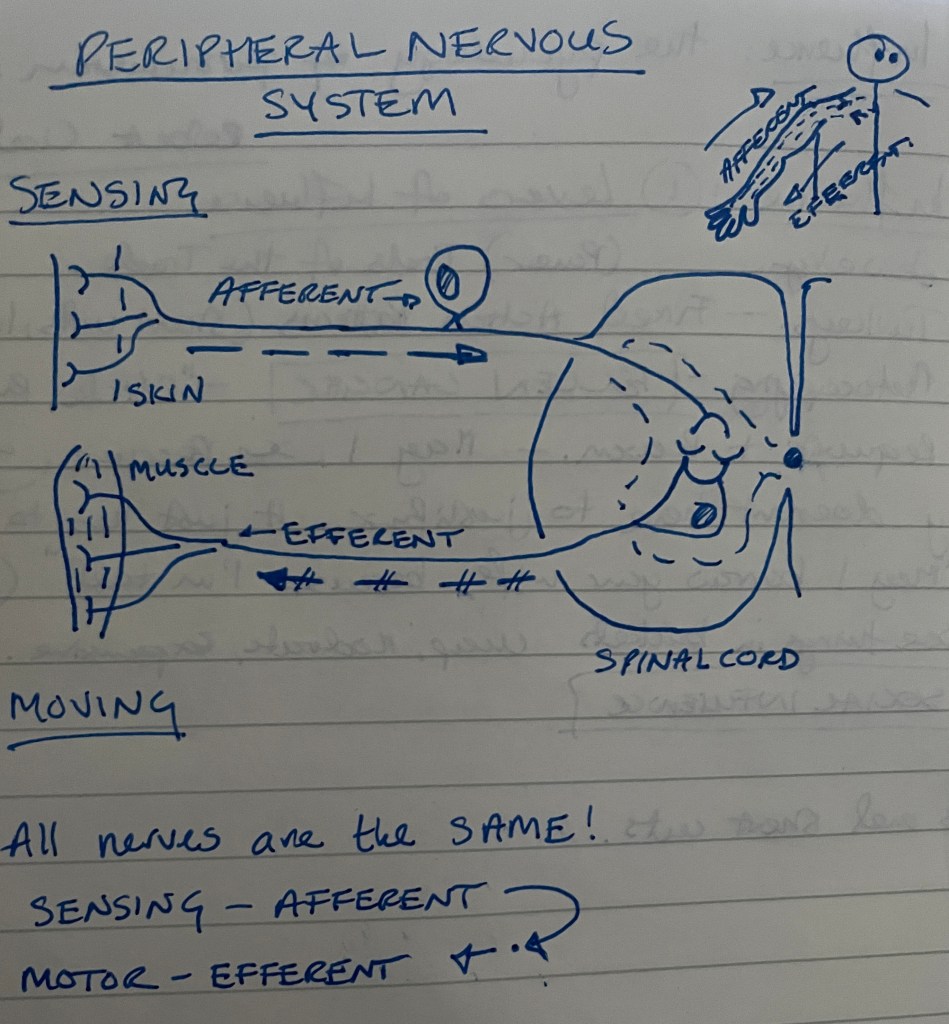
It’s normally at this point that people in classes are like – boring – what has this got to do with being a leader? Just this basic understanding of these explain how detecting the presence of a stimuli causes a simple chain of communication that you don’t have control over like when you step on a tack or bang your elbow or see something. The first reaction is automatic and the second is voluntary. These are the two sub systems of the PNS.
Autonomic Nervous System (ANS) – Maintenance to stay alive and grow
3.1 The automatic or autonomic nervous system works, unsurpringly without any thinking. It is involuntinary and this is a good thing as the amount of stuff that is going on to keep you alive without thinking is vast – breathing, digesting, pumping blood around, keeping blood pressure up, you get the idea. The PNS has loads of nerves that monitor the state of the body and look to adjust things to keep things moving (blood, food, water etc) through smooth muscle contraction and secreting hormones and other chemicals into the blood that affects the organs and circulatory system. Although the automomic system is automatic that doesn’t mean it’s invisible working behind the scenes. Many things you feel are from the autonomic system tell you how things are. This includes pain, hunger, thirst – all the stuff that you need to know about. These nerve messages get processed by the brain in simple and weird ways that I’ll explain briefly. For now think of it like your life support system (it does work when you’re asleep, unconscious) that just needs the brain to make sure all systems are operational (it doesn’t work when the brain is dead).
Sympathetic Nervous System (SyNS) – Running Action
3.1.1 The autonomic nervous system can be divided into two basic emotional activity states. The first one is the automatic activity of staying alive in the wild – movement away from danger (flight), move towards to challenge (fight), latter overcoming former (freeze) and special (‘ahem’) friendship (another f!). This system is called the sympathetic nervous system (SyNS – helpful to remember that sins come from this system). To be clear although this system is not always on but it’s always ready. When we see something we automatically react to that situation but one that can be altered depending on the situation. It prepares you to act.
Parasympathetic Nervous System (PaNS) – Relaxing Action
3.1.2 The second part of the autonomic system is the opposite to the sympathetic and that would be the parasympathetic (cos that’s para means defend, or in this instance beside). The parasympathetic regulates things when we need to relax and chill. Instead of running or fighting it gets us out of the stress as the stressed status is not good for you (high blood pressure and high heart rate is not a good default situation). The idea is to return the body back to a restful state. Due to the nature of relaxing compared to running it’s worth remembering that environment is crucial for this system to be running. It’s tricky to be chilled if you don’t feel safe and secure.
Somatic Nervous System (SNS) – Muscle Action
3.2 With the autonomic nervous system taking care of basic maintenance, and basic drives. The maintenance keeps things running and the drives give the push to move and this is where the moving or somatic nervous system (somatic means body). This is the voluntary part of the nervous system that moves us around based on the stimulus from the autonomic and from the central nervous system to move from one place to another (including reflex arcs which are automatic). As the system is voluntary the control comes from the brain. Ah yes the brain.
Summary
The NS consists of the CNS and the PNS. The PNS is divided into the ANS and SNS. The ANS is divided into the SyNS and the PaNS.
or
The nervous system containers all the messaging system for the body through electrical signals. Electrical signals with the body travel through sensing nerves (afferent) and motor nerves (efferent). The body as is kept in a stable state through the autonomic system and moved away and towards stability through the somatic system. The central nervous system made of the spinal cord and the brain bring nervous signals together to create a universal (body) response. There is a lot more but all you need to know is that humans emotions and influence are detected and reacted in the the nervous system. To feel is to be alive. To create positive and negative emotions whilst alive is more difficult.
Next – the brain. The three levels of “thinking”.
 Compsortia
Leave a comment