
Before I go further into the detail about the brain I thought it would be helpful to take a bit of a step back and review the brain structure as a whole and what words describe what parts and functions. As with everything about biology and especially neurobiology there are lots of Greek and Latin names that seem to be designed to be completely unrememberable so fear not if you don’t remember all the real names as I’ll be using a naming system that should help to piece things together.
Talking of piecing things together let’s start from the outside. Be prepared for some amazing drawings!
Part 1 – The Skull
Start nice and easy. The skull is the hard bone that covers the brain and made up of two bones: 1) mandible or jaw bone and 2) the cranium. So if you need to order a skull at any time make sure you get both bits. I’m going to be a bit cheeky (pun intended) by dividing the cranium into facial bones (those that make up the face and eye sockets) and cranium bones (the ones that cover the brain). Antamotically there is no difference but it will help when we talk about the brain parts later on.
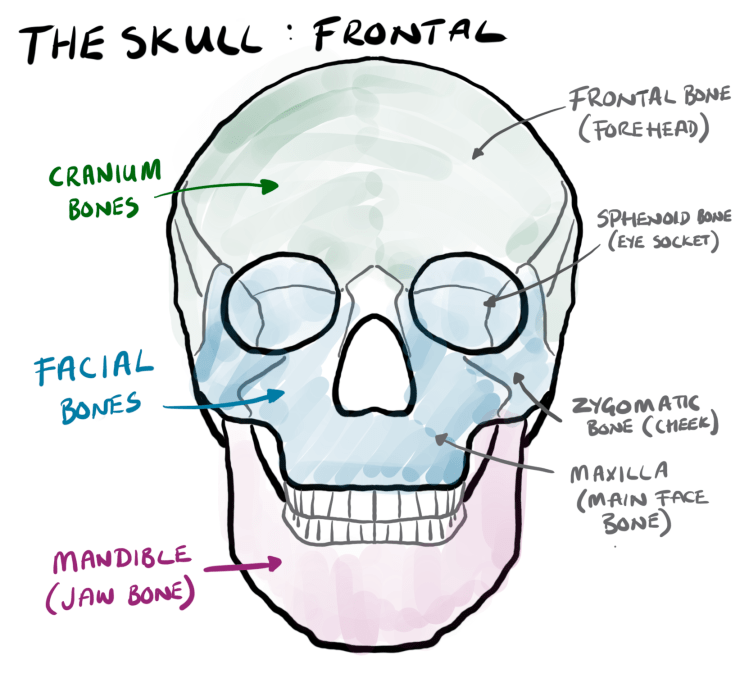
The Mandible – the Jaw Bone
The mandible is one bone that is attached to the side of the crainum via tendons the muslces that allow it to more up and down and side-to-side to chew or masticate (Greek for mastichan – chew/gnash with team) which gives the root of mandible (our reptile and bird friends can chew due to different jaw antonomy). This flexibility also allows for manipulation of the face to form different expressions.
Facial Bones
The cranium is more complicated but can be simplified to two many regions: 1) face (facial bones), brain (bones that cover the brain).
The facial bones are the ones that form the upper lip, nose all the way around to the side of the head. These bones create the openings for the eyes and the nose along with the top jaw or maxilla where the teeth join to the skull. Due to the complex nature of this part of the head there a lot of small bones (bones are really small plates that fuse or suture together) that make up the parts of the nose and eyes. Due to these smaller bones they are subject to breaking when the head gets hit. This can be an issue as the brain is right behind it along with a lot of blood vessels. Talking of blood vessels the nose structure is an interesting one. The nose is made of or the nasal bone and then cartilage that gives the nose it’s structure. When the nose gets ‘broken’ we are talking about the nasal bones at the top which hold the cartilage straight. If the nasal bones are not set straight that it were you get your wonky noses.
4 Main Cranium Bones
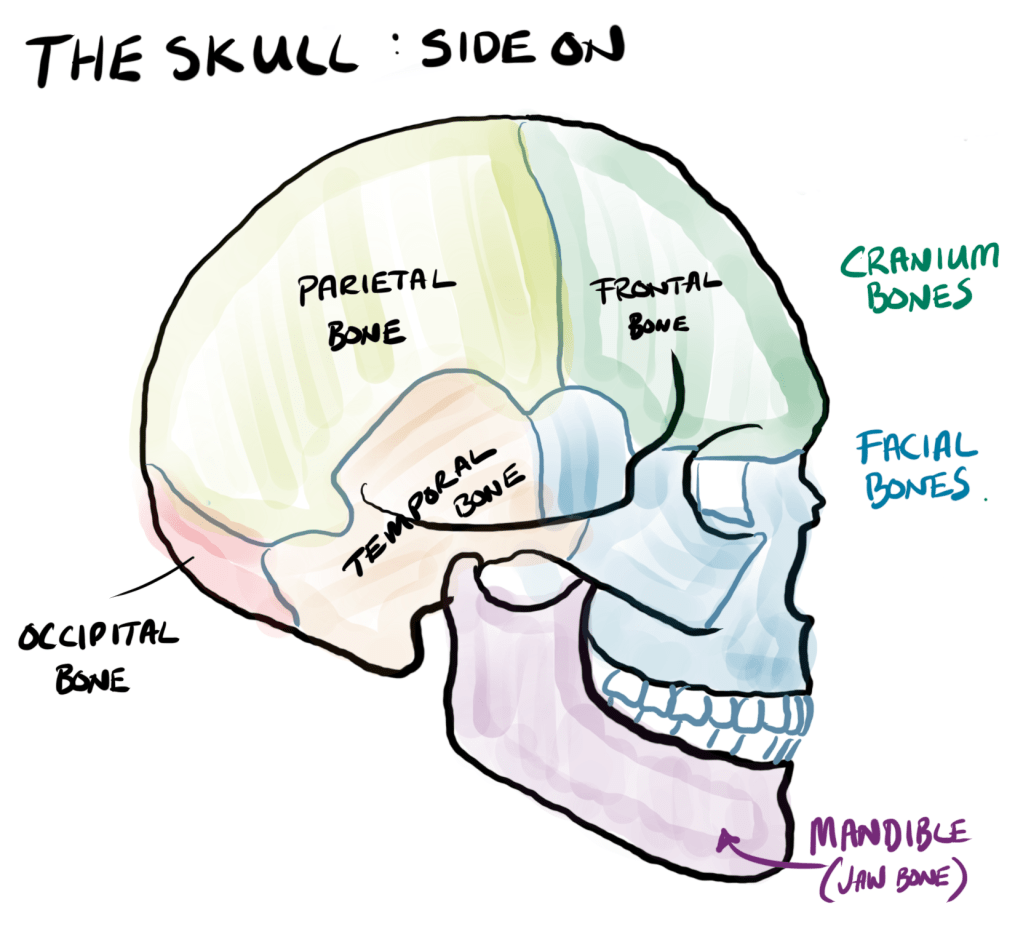
The rest of bones that make up the brain shell that provide that protective cover of the brain. A good place to start is the Atlas! One of the amazing things about the human head is it’s location and it’s weight. The brain is the central processing unit and the closer the brain is to the bodily sensors the better and that is why the eyes, ears, nose and tongue are right next to the brain for processing. By lifting the sensor as far off the floor as possible the further the body can see. Standing up-right and lots of sensors means a heavy head. To cope with that the skull head sits on top of the spinal column on the final bone called the Atlas Vertbra as in the Atlas from Greek mythology who has to hold up the heavens as he lost in the war of the Gods to Zeus (in reality it’s a mountain range in north Africa that would look like its the gap between the earth and the sky). The Atlas Vertebra provides the base for the cranium to sit on via hole called the foramen magnum (Latin: great hole!) formed within the occitipal bones. This hole provides the path for the nerves from the spinal cord into the brain not the blood vessels which come in from in front of the neck (carotid and vertebral arteries).

Once the cranium is sitting on top of the spinal column then four set bones cover the brain. From the front there is the frontal bone which makes up the forehead and eye sockets that fuse with the facial bones. Following the frontal bone on top of the cranium is the parietal bone (looking at it from the inside it provides the wall of back of the cranium). These come as a pair to cover the top of the head. For for the bones over the left and right hand side is the temporal bone that is above the ears. With the temporal and parietal bones making up the top and sides of the cranium the occitpital bone makes up the back and the base.
The four bones of the cranium: frontal, parietal, temporal, and occipital bones also make up the four lobes of the brain. Let’s move from the outside to the inside – the squishy stuff.
Part 2: The Four Brain Lobes – the Cortexes
If we took the cranium bones away leaving the facial bones that make the we would see a pink, jelly structure behind the face (it would look very weird). This is the brain and is made up of lots of parts but the thing you can see are the four brain lobes. Lobes are anything that are a rounded projections that forms a specialist area/function. Unlike the cranium bones the brain is bilateral (two-along side) which means there are two copies arranged in a mirror image. The brain is not a complete copy on either side as there are some parts that are in the middle and some that are more profound slightly more on one side.


Frontal Lobe
The frontal lobe is found at the front underneath the frontal bone. 2 semi-spheres that are associate with executive function which means high level reasoning, problem solving, long term planning. Also called the frontal cortex.
Pariental Lobe
The pariental lobe is found at the major upper back area of the skull under the pariental bones (one on each side) that is associated with processing sensory information mainly touch, taste and an under appreciated one – temperature. Also called the pariental cortex.
Temporal Lobe
The temporal lobe is found above the ears on both side under the temporal bones. The temporal area is associated with processing affection and emotions, language and many aspects of visual perception. Also called the temporal cortex.
Occipital Lobe
The occipital lobe is the smallest of the lobes found at the back of the skull and is associated with visual processing which is a lot of processing for a human as it one the main sense. Also called the occipital cortex.
And – the Cerebellum
The cerebellum (little brain) isn’t classed as a lobe as it’s a different, older part of the brain to the four lobes/cortexes. The cerebellum is a cortex in it’s own right but is different as it connects directly to the brain stem unlike the other lobes which context through the limbic system (although this is simplification of how the brain parts are connected). The cerebellum is responsible for balance, posture, voluntary movements along with long term motor learning (stuff you can do without thinking). The cerebellum is also involved in language and other cognitive functions so I’ll be bringing cerebellum in when we talk about motivation and behaviour.
Finally the Brain Stem
The last part of the brain that we may see if we took all the bones of the cranium away could be the brain stem – the connection between the body and the brain through a stem of insulated nervous tissue that is the channel between the nerves in the body and the brain. The brain is more than just a stem as it contains key parts of the nervous system that keeps us up and running e.g. heart beat, breathing that sort of thing. There are two main functions to the brain stem: 1) regulation of the bodies automatic function and 2) cranial nerves that control the muscles and functions of the face.
Now that we are two levels down the next level is to look at the brain underneath the lobes. If we were super lazy we would simply call this next level the limbic system so that is what I’m going to do (and because dwelling too long in brain anatomy is a bit dull).
Part 3 – The Limbic System
Things start to get a little messy when we enter the inner brain and the parts of the emotional or limbic system. The reason they get messy is due to the parts being smaller making them harder to render accurately in a flat picture. I’ve called out the main structures and components that I’ll be talking about.

 Compsortia
Leave a comment