

Computers are amazing – to some borderline magical, to others just the thing that does everything. What is definitely true is that computers are complex and without a good understanding of how they work they will be impossible to use easily.
Thankfully computers and what they do can be understood in the same way any machine can be. At Compsortia we believe that explaining things in layers, starting simple, this understanding can be reached depending on what you are trying to understand. In this section of the site we go into the history, engineering and programming of computers so that you can apply compute to your business, organisation, or even just for fun (that’s what we do).
We are simple folk so we have to take things slow. To get an idea of how computers work we need to appreciate two things: 1) the computer machine, and 2) the compute process. Both of these have a history so let’s start the journey there. If you’d like to skip to the inside of modern computers then look at the next section on computer systems or if you want to know more about computer programming then click that section (we strongly recommend you understand how a computer works before starting to learn program just so you know it is not personal when the computer doesn’t do what you say.
In order to understand computers we need to take a little step back to set the context of what computers do and how they do it. This shouldn’t take long and it’s a nice story. We start with tools – things we make to make our lives easier, then bigger tools – machines. After that background we briefly look at electricity and how that is the backbone of computers and finally basic electronics which allow computers to be built and how they can fit in your pocket.
Tools – simple, no moving parts
Our journey starts roughly 2,600,000 (2.6 million) years ago in the Stone Age with what is thought to the time that humans started to use tools – specifically manufactured objects for a defined task. Smart archaeologists know this as they have found stones with deliberate dents on the tool surface and sharp bits that have fractured off that could be used for hunting, working with skins and other materials. Fast forward a couple of million years and we see more complicated tools where more materials are used and different materials are used for different uses such as handles to hold sharp stones to produce simple knives and spears.
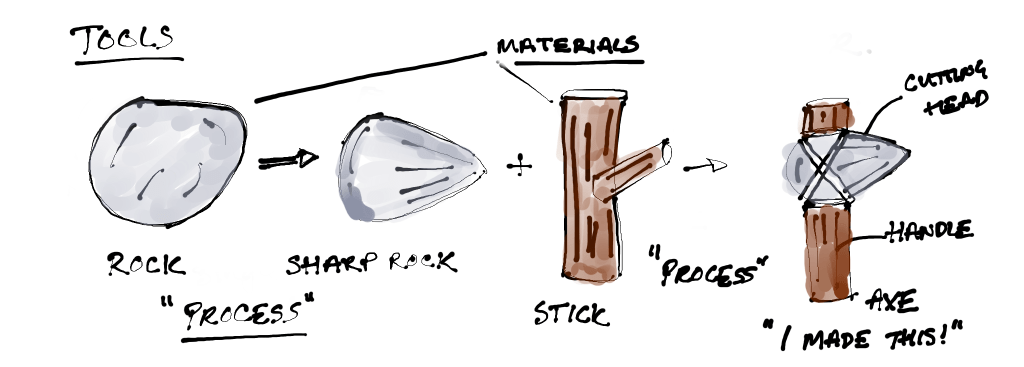
This evolution continued until a break through – metal – around 9000 years ago. Copper seems to be the first along with tin which mixed together made bronze and hence we move from the Stone Age to the Bronze Age. We now have both sophisticated tools and sophisticated processes (defined inputs, defined processes, desired outputs).
The next stage is iron – the work horse metal of the ages (gold and silver are nice but not practical) which brings us to ancient history where the smart Greeks, Egyptians, and later Romans bring in writing and mathematics. Iron is a very strong metal so can be used to support things and used for hard tools – bashing things (hammers), cutting things (knives), even joining things (needles), chains etc. All good for civil and uncivil things (war).With more tools came better engineering and bigger tools where things could be joined together – machines.
Machines – complex, lots of moving parts
Machines start where tools start to scale. As tools got too big for an individual to use or carry a machine could be used. The first simplest machines started around 3500BC when the first recorded wheels were found. Attaching circular discs together via and something balanced between them and a cart is created. This changed everything not only in transport but by using a new form of energy – animal power.

With the smarts of mathematics, a passion to conquer (fight) the world, and survive the environment meant more machines took on the work of people where there was an ability to create machines.
Electricity – charged amber
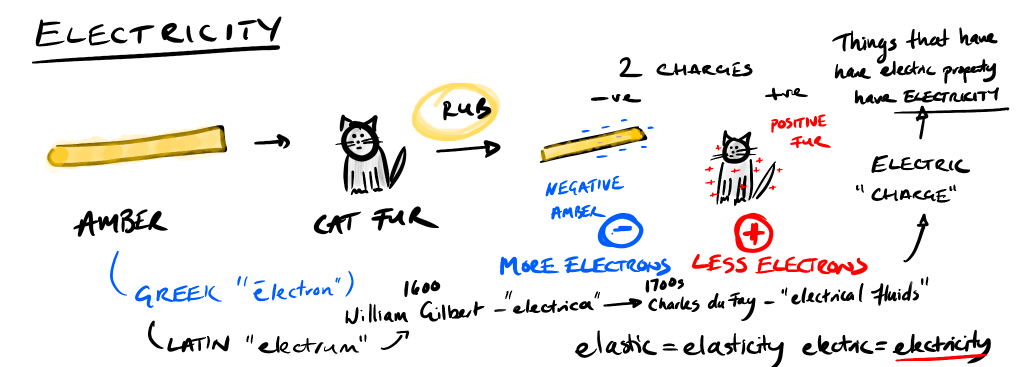
Those Greeks didn’t just their spend time thinking about the world they experimented in it. One of those experiments was with amber, fossilised tree sap, that when rubbed with animal fur (cat was preferred) would produce an effect which would deflect very light feathers when moved close it. We now know this as static electricity where there is an attraction or a repulsion depending on what charge is in excess or deficit.
Fast forward to the 1600s and we’ve moved a bit further towards understanding electricity but not a lot. This period was the time of scientific revolution with the many famous scientist determining a few tricky truths. In the heavens we have Galileo and Kepler proving the Earth rotates around the Sun in orbits. Then one of the most famous scientists Newton proves mathematically how gravity “attracts” large things so orbits are possible. It was all kicking off in the sky.
On the ground things were also moving forward but with names less likely to ring a bell. In the field of electricity William Gilbert produces De Magnete which brings magnetism (more in a bit) and electricity together by showing charged materials (like the amber) attract and repel each other like magnets but are not permentant – they neutralise on contact. We start to know about charged fluid as it can be transferred from one material to another. Then we know there are two particles that are charged (we can get electrical shocks when metals are ‘charged’ up – they have electric like properties or they have the property of electricity (with the suffix -city mean something that has that descriptive property e.g. elastic has elasticity, or a fierce dog has ferocity etc).
Magnetism – happy attraction
At the same time as this is going on magnetism is also been studied as it had a practical use in compasses as the Europeans where either at war with each other on the oceans or selling stuff to each other on the oceans. Ships getting lost and sunk was expensive. W
It wasn’t until the turn of the 19th century when electricity and magnetism come together.
Electricity and Magnetism – the perfect couple
Electronics
Computers systems can be looked at at two levels
- Single computer system – the components that make up a stand along computer
- Multi computer system – multiple computers networked together
In the GCSE Computer Science both parts are covered in exam paper Computer Systems.
This paper examines the following topics
- Systems Architecture
- Memory and Storage
- Computer Networks, Connections and Protocols
- Network Security
- System Software
- Ethical, Legal, Cultural, and Environmental Impacts of digital technology
Let’s have a look at each topic in turn and work through examples.

 Compsortia