
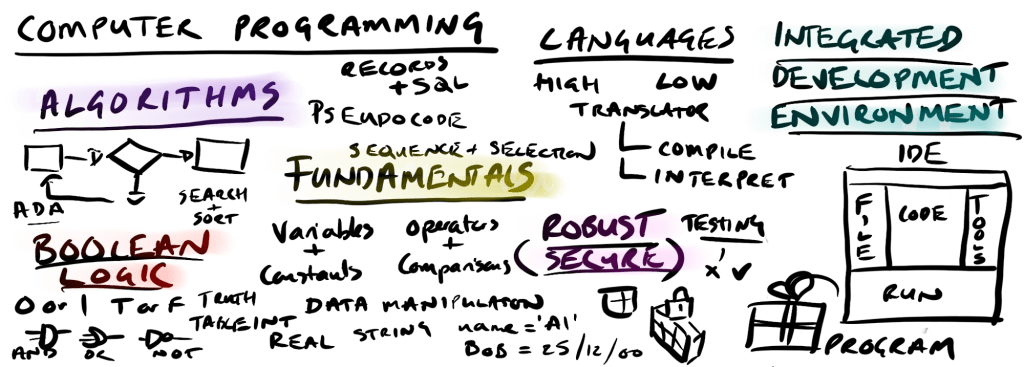
1. Algorithms
First up is how we break problems down so that computers can provide an answer through a written program.
2. Programming fundamentals
Algorithms give us an idea on how we can start to build a way to capture inputs, process them and then deliver outputs but what are the parts we need to start writing computer code. For this we need to appreciate the fundamentals of how a computer language is written and how a computer reads it.
3. Producing robust programs
Computers work very fast and some store very sensitive information be that financial or personal. Either way for every good coder there is a bad one looking to exploit weaknesses. Securing a program starts at the start with defensive design rather than when something has gone wrong.
4. Boolean logic
We look at Boolean operators in programming fundamentals as a way of checking variables. Here we look at how, at the heart of the computer, a program works – tell the computer to make logical paths based on the status of data it gets.
5. Programming languages and Integrated Development Environment (IDE)
The last section looks at the where most programmers start – a programming language and an integrated development environment (IDE) and a book or online course. Before kicking off into the world of programming we look at the different types of programming language (and there are lots) and how they are translated so a computer can execute the code. Finally most languages come with a single tool to help with writing and testing new code this is called an Integrated Development Environment (IDE) and it’s where developers spend most of their days (along with StackOverFlow but that’s another topic on getting help.
Let’s have a look at the first topic: algorithms >
 Compsortia