

Enterprise
Home > Enterprise Functions
Welcome to the world of enterprise
If you want to be successful in your enterprise then you need to know four fundamental functions. Master these and you are half way to being successful in business. The other half is hardwork (that’s from you – can’t really teach this). If you want to know why you need to know these function skip to What is an enterprise further down the page.
The Four Enterprise Functions
These are the four functions you have to know about and we will walk and talk you through to build a successful enterprise.
STRATEGY
Do you have an idea for a business that will make money? Do you have an idea that will help people without making money? Excellent. Do you have a plan on how you are going to sell those goods to those waiting customers at a price they want and a cost you can afford? Awesome. Then you will have a strategy as all that strategy is is a set of decisions that you will make depending on circumstances at the time. Many will tell you that a business strategy and plan is vital. They are wrong.
There are many successful people that use their knowledge and sense to make decisions with nothing written down. What they do have is a guide or map to guide them even if that is purely in their head in the same way that a London taxi driver had a map in their head of the best route at a certain time of day or if there is a blocked road.
In the strategy function we will give you all the maps, schemas, frameworks, canvases, visions, etc to help you build your map for you to be successful. It will also help if someone does ask for your business plan when you are asking to borrow money.
The key is to keep it simple and actionable. If you don’t understand how to action a strategy it’s too complicated and won’t work.
MARKETING
Selling things to people to make money. To do this you will need a couple of basic things: a product to sell, a place to sell the product, a customer to buy the product, a process to transfer money from customer to you. Marketing aims to get your product in front of a customer and make them an offer that would be hard to refuse (it is business, not personal, and legal – no horses heads).
Marketing has a structure and a clear set of practices that you will need to understand if you are going to effectively sell products to customers at the optimal price. In the marketing function we start with the basics of selling – convincing a stranger to swap their money for your product (friends and relatives are not a sustainable customer base) before moving on to selling at scale where you’ll come across a lot of Pees: product, price, promotion, place, pentagon (made that last one up to check if you were following).
The key to marketing is endurance – you have to be on it all the time as marketing is based on time as customer circumstances change with time. Get a calendar and a pen and get ready to learn how to market and sell your product to make money.
OPERATIONS – making things to sell AND filling in the write forms to legally run a business
FINANCE – managing the money needed to run a business
These four functions cover 95% of things you need to be aware of to get started and then run a business. Exciting stuff. That’s the good news. The slightly bad news is that a lot of these functions can get complicated and even boring. However, if you take the time to learn even a little about just the fundamental functions you’ll save time, money, and personal energy to build your business.
WHAT IS AN ENTERPRISE?
Let’s start at the beginning. What exactly is an enterprise? And how do the four function work together to make a successful enterprise?
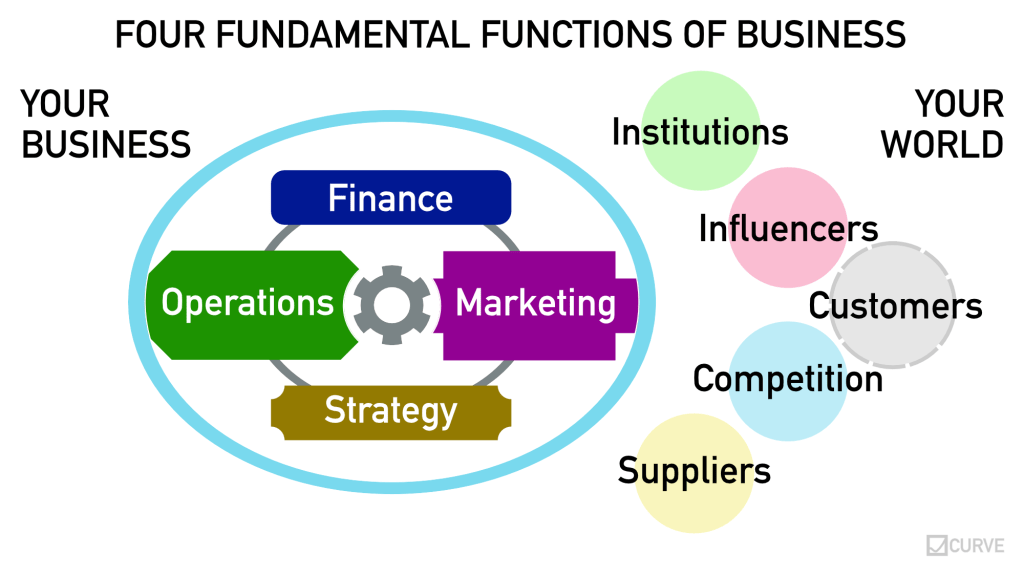
Below is a schematic diagram of a business in the blue border. This pretty much every person or business out there. Everything inside the border is a business with the four functions working together as one can not work without the others. In the middle there is a cog that moves the business forward through work or business activities.
Outside the business you have the world in which you and your business live. In this world there …
Before we get into any detail I need to very straight with you. The reason for the harshness and directness of tone is that many people dream of being their own boss, running there own business, and enjoying the lifestyle that comes with not having a boss.
Whilst there is freedom when you have your own business there are many challenges and stresses that come with not have a steady salary, holiday and sickness pay, insurance, pension. The main stresses that a business owner has are based on money and generally not enough of it when needed.
The need for money creates three golden rules that you should never ever forget when setting up and running a business.
3 GOLDEN RULES OF BUSINESS
- You have to sell
- You have to control your costs
- You have to make a profit
These three rules will keep you awake at time, get you out of bed, make you create great products, and give you a work-life balance that you want when owning your own business. To get that work-life balance you have to realise two person rules of life
2 GOLDEN RULES OF LIFE
- You can’t do everything by yourself
- You get more when you give things away
I’ll come back to the golden rules of life. For now let’s look at the business rules.
RULE 1: YOU HAVE TO SELL
This is one of the hardest parts of running a business – selling. For some it’s a very natural thing to do but for many this is the number one challenge as it can be uncomfortable. This uncomfortableness comes from two main challenges.
- You are selling a poor product
- You are selling yourself
Point 1 – selling a poor product is all about thinking the product you have created and trying to sell is not very good – poor quality – and that reflects on you. You have pride in your expertise and your work and you know what good is when many around you don’t.
This expertise means you don’t want to sell your product until it is good enough to sell. Fair enough. However, this takes time and money for features that the majority of your customers will not care about. The fear here is that the first impression will be poor and that you have blown your chance of running that dream business.
The reality is you get as many chances as you want as customers will return to try your product if they want it. The skill is producing a product early that gives you insightful feedback as to what you want to do (supply) against the price the customer is willing to pay (demand).
KEY POINT: Selling is learning. Test the demand for your product as early as possible to learn what the customer wants, how your competition may respond, and what costs are incurred in production.
Point 2 – selling yourself is all about putting not your product on the table but you. It doesn’t matter if you manufacturing widgets in the millions or a personal service for one person when you own the business it becomes personal especially when the business is just starting out. You will have to put yourself out there and convince another human being that the thing you have they should want and they will pay for it.
This is hard selling and you have to get used to the knock backs when you are trying to do this. For the vast majority of interactions you will be ignored. You will be crying from the roof tops about your product and you will get no interest. This is not because people are rude (although you will find many are) they are just busy and the thing you are trying to communicate they are not interested in at the time. All this shouting is tiring and can feel pointless when you don’t see any response to the superior product you have made and are offering.
If you persist you will get interest and enquiry. Much of that interest will be positive and you will enjoy people asking you about the product leading to sales and the dream of running a business a reality. Some, and a surprising amount, will not be enjoyable many of the questions will be asking about details of the product it clearly doesn’t have or, more commonly, asking about the price and how it can be reduced. All this feedback is good as you are in control of it. Every conversation is a potential sale even if it leads to you putting in place a process for handling time wasters e.g. “No discounts – Don’t ask”.
These conversations will feel personal and a times awkward. You will ask yourself ‘is this worth it?’, ‘may be I should drop the price?’ ‘maybe I’m just not cut out for running my own business as I hate the sell – it feels wrong’. All the answer to these questions is ‘probably – you need to try’, ‘not unless you absolutely have to’, ‘you’re fine – you just need to practice selling’.
Everyone can sell; not everyone can sell well. Everyone can get better at selling through practice. That practice comes at different levels which we cover in our marketing function but for now you need to be ready to talk to people about what you have the money you for it as that money is needed to cover your costs.
RULE 2: YOU HAVE TO CONTROL YOUR COSTS
In the world of business there is an old phrase
Cash is king
This may seem obvious but many, many business fail for one reason – they run out of cash. This leads to the obvious question why? The answer: costs. You have to control what you spend if you want to run a successful business. If you don’t you won’t have a business – you have a hobby (you don’t care if you lose money as you just enjoy the fun of doing it).
Costs, expenses, or money out, are things that cost you money. Strictly speaking costs are not always cash like you have in your pocket or bank account (see profit for how expenses) but for the vast majority of the time any money that is going out of your business it will be cash in the same way that any money that comes in will be cash in the end.
Getting to grips with costs is a two edge sword
Edge 1: not spending enough in running and growing the business (hoarding money instead of investing it for greater returns
Edge 2: spending too much money that the business can not operate. When a business gets to a point where it can not operate due to a lack of cash then it can longer operate – it’s either very unhealthy or dead (the Monty Python Blue Parrot Sketch may be a good metaphor for a conversation between a business owner and a bank or creditor).

It’s dead that’s what’s wrong with it
Nah, nah. It’s resting look.
Monty Python Dead Parrot
Business with no cash are likely to be close to, or actually dead regardless of what the owner thinks
that business is bankrupt. At this point the business is over as it is not the business that states that it is bankrupt but another legal entity which states the business can not operate freely as it has to pay off its debts. Bankruptcy only applies to individuals and partnerships i.e. people – people are declared bankrupt. Corporations (legal entities ) are either liquidated or put into administration. This difference is immaterial as many business owners put their own money in and will borrow to grow a business so when the business falls regardless of its legal status it’s going to hurt.
On a similar note insolvency is another of cash flow problem but unlike bankruptcy is not a legal position that a person or business
RULE 3: YOU HAVE TO MAKE A PROFIT
Don't apologise for wanting to make money from your product, services or time. That is the business; it's not personal
BUSINESS MODEL
Your business will be made up of at least the following
- A human being making something
- A location where that human being will work
- A product that the human being creates
- A process to make the product
- A tool to make the product
- A legal framework in which the business operates
These six things a factors that create a model for the business where a model is a simplified version of how things actually are. Simplicity is crucial as you need to make decisions at the best time with the best information to grow your business.
The simplest business model is made up of the four fundamental functions. These four functions are linked to create a single operating system regardless of how small or big your business is.
Exercise – think of the simplest business
STRATEGY
Strategy – a little goes a long way.
There are lots of books, courses, guides, tests etc that help your business being success
Economics – understanding demand and supply to set your prices and

 Compsortia