
One of the fundamentals of product marketing, sales and finance is to know where the products you make are in the present and may be in the future. To try and place a company’s products it is helpful, if not essential to place them in the product lifecycle a fundamental of product management.
The reason to know where a product is to try and answer these two crucial questions:
- How do sell this product (should we keep selling this product)?
- How much profit should we make per product sale (profit = sale price – cost of sale)
For example we have a widget that we have been making for 10 years. For the last year sales have dropped by 5% but the profit has been stable due to a reduction in cost of sales evening out the total revenue and profit. Is this a product something a company should continue to invest in?
a) Yes. The product is still generating stable profit so we should continue to invest in it (marketing spend, upgrade to manufacturing operations, etc)
b) No. Volume of sales is dropping off. Further investment is a waste of resources and time. Should invest in new products before cost of sales become greater than sales price.
These may appear to be two extremes but they are serious questions that product managers will have to answer. Where it gets tricky is where one product manager will have their product replaced by another product managed by another product manager.
To understand how to answer this question let’s look at the classic product lifecycle put forward by Theodore Levitt in 1965. Let’s have a look at the product lifecycle and then how it fits into the skill of product management.
The Classic Product Life Cycle
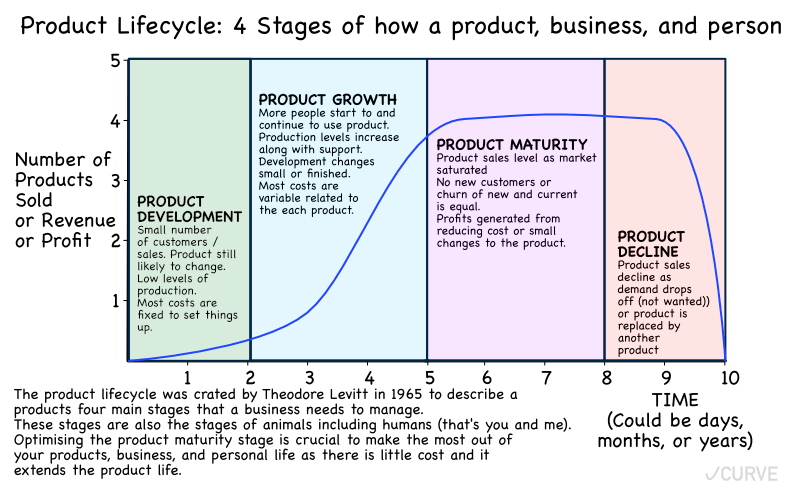
Stage 1: Product/Market/Business Development (Personal Development)
The first stage is both the simplest but also the hardest.
The reason it’s the simplest is due the number of moving parts; at this point there will be a smaller group of people developing it, relatively small amount of money, small time frames, small number of targetted customers, etc. That makes it a little easier – that’s the good news.
The reason it’s the hardest is that there is very little time to prove that the product under development is a profitable option. Profitable means that it’s a product that will grow the company in the long term meaning it doesn’t have to be one that a customer is buying (business-to-customer: B2C) but can between another business (busines-to-business: B2B) or different combinations of the above.
At the product development stage there are some essential things for a product manager to do:
- Identify the user who has a problem that this product will help solve.
The product doesn’t have to be an actual “problem” but something that a customer wants.
For example Netflix didn’t solve a problem of people not having anything to watch. They solved a problem of demand allowing people to watch lots of different things when they wanted. Coca-cola didn’t solve a problem of thirst but created a taste experience that people liked and wanted to more of. In both these circumstances the user was someone who wanted a better experience to what they currently had be that watching video or enjoying a drink.
If you do one thing in the product development stage is get an idea about the user today and tomorrow. - Identify the market the product will work in
The next thing to know about the product is what market the product will be bought and used in as this will define the stability, competition and regulation that the product will have to grow in. Not knowing this at the beginning can lead to confusion on marketing and expensive redesign if the product does need to be mass produced. - Identify the levels of product use
Kano Analysis
Used Apple Policy – never first, never last
Personal Maturity (0 – 18)
Growing into an adult including puberty until bones fuse. Finish of state education. Start of adult.
Stage 2: Product/Market/Business Growth (Personal Growth)
How a product starts to gain traction and the hardwork of development is seen in use, revenue and profit.
Personal Growth (18 – 30)
All growing in bones is done. This looks at gains in mass and mental maturity.
Stage 3: Product/Market/Business Maturity (Personal Maturity)
Personal Maturity (30 – 70)
How we mature in physical and mental performance
Stage 4: Product/Market/Business Decline (Personal Decline)
Final stage. The product declines in the market for two main reasons
The final stage of a product’s lifecycle is where consumers no longer wants the product the manufacturer makes or the products availability is restricted either deliberately by the manufacturer or by an external force (materials not available, substituted by another, competitor’s product). Here’s those two situations in more detail.
- Product no longer valuable in the market
Could be due to changes in personal or social choices (e.g. plastic to paper straws) or changes to legal structures and regulations (e.g. diesel to electric powered cars). These changes can affect all products in the market but also specific brands that are more exposed than others due to a lack of long term investment coming forward. - Product replaced by competitor product
Customers swap from one product to another due to advantages of using that product. Advantages can be the price for the individual product (the competitor is cheaper), higher quality when compared (other product has additional features even if not used), or comes as part of a product bundle creating a lower price and additional features (product bundling allows for the competitor to add marginal benefit (which the customer recognises) without a large marginal cost (commonly a something that is free to the producer). In the 1965 paper Levitt uses the example of nylon stockings or tights replacing silk ones. Nylon was far cheaper and easier to handle replacing silk as the main material. Silk stockings can still be bought but the market today is tiny compared to nylon.
A business can and should decline their products as part of their overall product strategy. However, a lot of companies do not resulting in products declining incurring higher costs. One of the hardest part of the decline stage is knowing when to decline a product instead of trying to keep it in the mature phase.
The decline phase can take a very long time with a group of customers remaining loyal or even peaks of new interest is the decline is seen as a last opportunity.
Don’t confuse the decline phase with a business deliberately leaving the market. The product lifecycle is driven by the demand for a product in a market place not the businesses choice to not make it.
Personal Decline (70+)
There is no easy way to say this but we all get ‘old’ and by old we mean your physical and mental performance starts to decline. In medical terms this is called geriatric pioneered by Dr Marjorie Warren who changed the mindset of many medical professional that elderly people should not be seen as one where rest and food was all that could be done to one where many aspects of life could be improved with the right conditioning and treatment especially for the so called geriatric giants: immobility, stability, incontinence, and mental impairment.
 Compsortia