

Entropy, Emotion, Emotions, and Energy
To best explain the J Curve Performance Model it’s best to here it from it’s creator J (he wants to stress that it’s not named after him).
Hi there. I’m J and I came up with the J Curve Performance Model and the 5F Change Framework. I did this after studying in a variety of fields including science and business where I worked both as a science researcher and as a business consultant. Through the journey I’ve studied how things change – go from one form or state to another. My fascination has been in the driver of change or the cause so that it can be either appreciated at or, where possible, controlled and harnessed.
Throughout my work (research would be far too grand a statement) I’ve concluded the following.
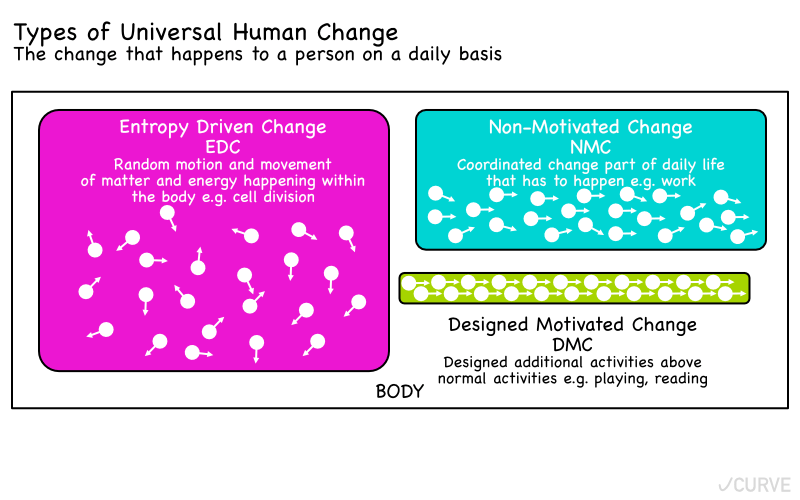
- Everything changes due to chaotic changes in the environment (space) and as time passes. This I will call entropy driven change to signify the change due to a system moving from a high energy (high order) to a lower energy state (low order). This is background change and there is little you can do about it. As you get old your life will experience two forms of entropy driven change: 1) You will have more moving parts that increases the level of entropy (the things you are involved in) and 2) You will have less moving parts as you age and your biology becomes poorer (Sorry but this is the case after you’ve passed your mid 20s). Here’s a nice article to describe Entropy: the hidden force that complicates Life.
- Changes can be nearly instant but is commonly so slow it’s not noticeable. I will call this life driven change. Some single events in your life will change you forever. These can be good like getting a qualification or perhaps winning a big prize. They can be bad like being involved in a serious accident or a convicted of a crime. These are rare events, normal not accidental, and visible. The vast majority of change that a person experiences are invisible either because they are too small to spot or internal. These micro and invisible changes happen over long periods are lead to both increases in performance through exercise or better diet or the opposite of decreases in performance through a lack of movement or poorly balanced diet. For these biological changes the body is just responding in a chaotic, chemistry way to the stresses and environments it is put in. The body doesn’t ‘do’ anything in the same way that a bacteria doesn’t do eating or respiration – it is purely a result of chemical differences (concentrations) and environmental stability (temperature, flow, compartmentalism). Change here can be managed as you can change your life for better performance differentiating it from the entropy driven change mentioned before.
- The older we get the harder it is to change. I will call this emotion driven change. As we get older we are supposed to get wiser learning from the mistakes from the days that have passed. Sadly, this is not the case. The reality is for many of us everyday does not bring more wisdom and openness but the opposite as we seek out not experiences that challenge our beliefs but ones that confirm them. As we get older the ability to change a for of static thinking or mindset becomes hard due to rewarding the parts of brains with information that confirms our position. This used to confined to our local tribe, village, town and country where information was sparse but today we have access to information from all over the world, all of the time, that confirms our beliefs and fears. One of the reasons thinking more open becomes harder as we get older is due to our thinking being set or inelastic thinking. This position is not fixed. The brain and then beliefs of an individual can be change through a change in exposure of information creating elastic thinking. The process is the same as working a muscle to change from inelastic (doesn’t stretch) to elastic does stretch over days, weeks, and months of work.
- Energy needs to deliberately applied to create wanted change. For both life driven change and emotion driven change there is an exchange of energy as a person lives. A human has a base level of energy use which is the minimum like one would experience if asleep. Any activity above this level requires energy with rising levels the more movement and thinking an individual produces. The human wants to be at the lowest energy, lowest stress position it can be. To spend more energy it will require shifting from a passive position to active one. This shift requires an activation energy that is based on a motivation to act be that move or think. Being able to lower the activation energy to act raises the possibility that a wanted activity will take place. This combined with the lowering of environmental blockers increases the ability to practice an activity that can increase performance.
In summary
The universe will happen to you
You will happen to the universe
The universe doesn’t care
Choose to live a life at a standard that you chose not what the universe defaults
Choosing requires energy
Use energy to drive change
J from J Curve
These conclusion created a model that I think can be useful to those wanting to change to a higher performance of life (stronger, fitter, happier). The model is simple and probably not unique but I’ve not seen it around on my readings. Let me explain the principles or fundamentals of the model
You are fixed in the short term but flexible in the long term
The idea that you, a human being are a collection of fixed and flexible properties is probably something you are comfortable with. Your height is largely fixed, your number of arms is probably fixed, the number of brains also hopefully fixed. Flexible properties can be classified as short term with levels of glucose in the blood or blood pressure over the long term physical properties include your mass, your strength, and your cognitive or thinking abilities. All good. Nice and easy to understand.
There are properties that are fixed for the short term but over time will change or become flexible. An obvious one is your muscle flexibility. If you stretched to touch your toes with straight legs you’d reach to a certain level. If you stretch a little longer you’ll be able to go a little further but not too much. Your flexibility is fixed. However, if you tried stretching every day for a couple of weeks the range of movement would be greater.
So you have truly fixed properties defined by your genes (brain, arms). Flexible properties defined by your state (blood pressure, glucose levels) and Properties that are semi-fixed/semi-flexible (strength, flexibility, weight). There are other properties that are self-defining that I’m not going to cover as these are very personal and can only be measured by the individual e.g. sexual orientation).
For many these different types of properties are all fixed as they are seen as what the individual is – it’s who I am, they are always like that, they always do that. The reality is if you can stress a property in a flexible dimension you can change it from how easy you can touch your toes, your blood pressure, and your thinking (can’t make you taller, give you more hair, straighten your teeth – sorry).
Economics forces of change
The idea of properties being fixed and flexible is the world of economics where smart people try to model how things will be in certain conditions. A fundamental part of economics is looking at two properties and comparing how one changes against another when something changes.
The most common economic model is how price of a product affects the demand and the supply for the product. Nice and easy. Let’s have a look at price and demand first
Price and Demand – One goes up the other goes down
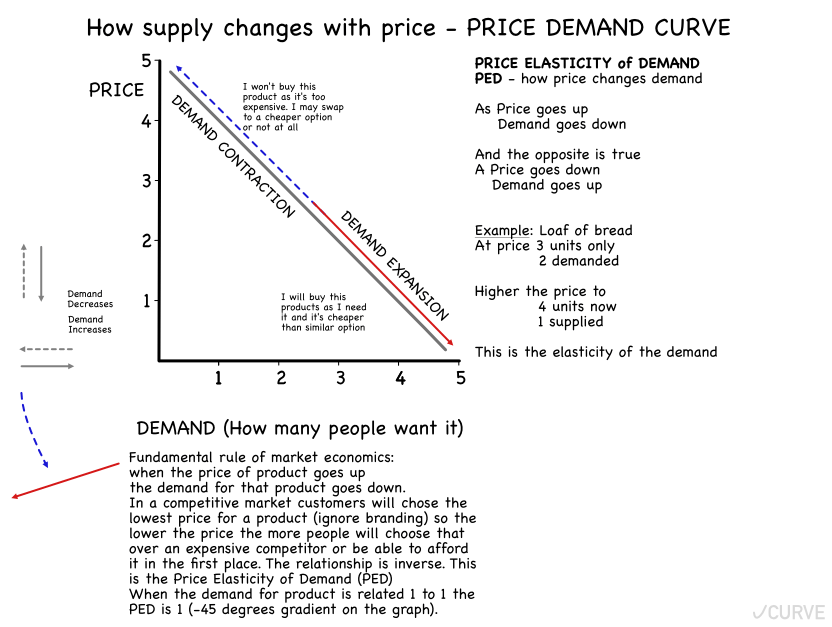
A fundamental rule of free market economics is that customers will pay the lowest amount for a product when all the products are identical. With this fundamental rule accepted it makes perfect sense that is a supplier increases the price of their good but a competitor does not then that supplier’s customers would switch to the cheaper option. This rule creates an inverse relationship between price and demand: the higher the price, the less demand.
Price and Supply – One goes up the other goes up
The supply of a product to a market is the opposite of the the demand curve. Where the demand curve decreased with price supply increases with price as an increase in price comes with an increase in profit therefore becomes a more attractive market to either enter or increase production to. Like the demand curve this is a simplification as many factors may not increase supply e.g. tax, but for simplicity increases in the price of a product normally increase the supply of that product.

Personal Price and Demand for Change
What has free market economics got to do with personal change and improved performance? There are critical similarities between the how the free market and how people change. The key here is the result of the market is the result of two forces at play: the price or cost of something that has to be paid and the force of wanting that something.
Change must be cheap – Big change can be too pricey
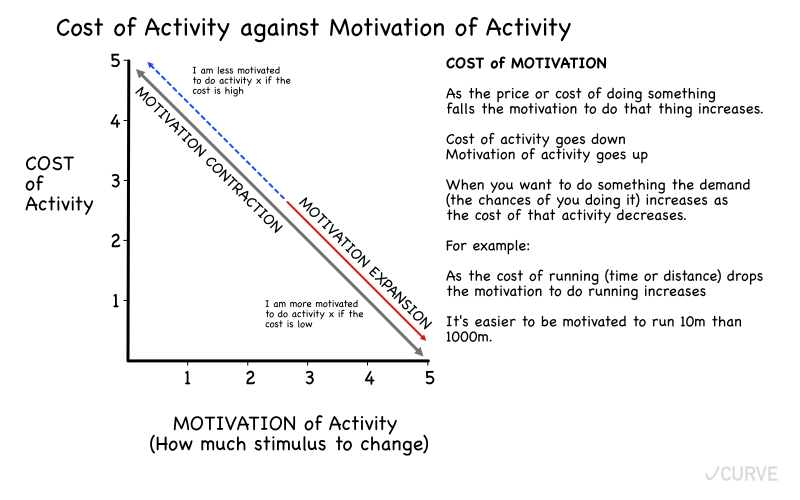
The ability to accept a new state comes at a cost (price). This can be time like in the form of physical exercise or it can be a mental exercise to learn something new or take a new view point. The higher the cost of the change the lower the success of the change and crucially vice versa – the lower the cost of the change the higher the success of the change. This is may seem like the most obvious thing along with the lower the price of a product the higher the demand for that product. However, the number one reason why many changes do not succeed is because the cost is too high commonly through the change being too ambitious e.g. I want to lose 10kg (22lbs), I want to life 40kg (88lbs), I want to be grade 8 piano. These examples may be seen as long term goals or end points however if these are not broken down then the change is unlikely unless a significant investment is made or the change is forced upon someone.
Price is set at maximum demand and minimal supply – market equilibrium
If the price of a product or the cost of change has to be small to create demand or motivation to change how is the price set? The simple answer is price is set where the supply of a product meets the demand. Typically over supply of a product will reduce the price as the supplier tries to get rid of the stuff already supplied. The opposite is also true – under supply of a product can increase demand and that can push up the price (this only occurs where demand is in excessive of supply).

The picture above shows how the increase of demand for a product increases or expands supply or production. At the same time the rule that lower price drives higher demand creates an optimal point of supply where all the product will be bought by customers around this price. The point where supply = demand = price is the Price – Demand – Supply Equilibrium point or simply PSE.
Your biology and the free market
Before I get into how free market economics or supply, demand and price is similar to how you perform I need to explain a little biology most which you will already know as it’s the basics.
The first thing is energy or performance currency. This comes in a few different layers and types to determine how much you spend in a day depending on the activities of that day.

1: Living Not Being (BMR)
The amount of energy you spend just staying alive is amazing. It’s estimated that between 65 – 75% of your daily energy spend goes into just staying alive: breathing, pumping blood, keeping warm, growing and repairing. If we take the lower level that means two thirds of your energy is spent just staying alive.
To put some average numbers on this:
| SEX | Average Daily Energy Intake (Kilo Calories / Kilo Joule) | Energy to Stay Alive 66% of Daily Energy (BMR) | Energy in grams of fat (8kC /gram) |
|---|---|---|---|
| Male | 2,500 | 1, 650 | 206g or 7.3 oz or 0.46lbs |
| Female | 2,000 | 1,320 | 165g or 5.8oz or 0.36lbs |
In the table above you will notice that if you consume a diet of the average number of recommended calories (either 2,500 or 2,000 depending on being male or female) then the majority are spent doing nothing. This “doing nothing” at the very smallest level of movement is called the Basal Metabolic Rate or BMR. This level is the level of energy if you are unconscious or asleep so no movement, digesting or even thinking.
Basal metabolic rate (BMR): The rate of oxygen uptake at rest in the fasting and thermo-neutral state.
W.P.T. James, in Encyclopedia of Human Nutrition (Third Edition), 2013
From an economics point of view this the minimal supply of products that creates a basic market in the first place. At this level weird economics happen so let’s not dwell here and more to the next level of your energy.
Level 2: Doing not Living (NEAT)
The next level of energy use is one where we are going around living our life but not under stress. This level is called NEAT or Non-Exercise Activity Thermogenesis or your awake state where you are awake and doing all the basics of moving around, eating, thinking etc. In this state you’re not doing anything exiting, you’re relaxed, you are in a state of non-aroursal (I’ll come back to this when I explain how you move from relaxed to aroused or excited in the section of psychology and neuroscience) .
NEAT – Non-exercise activity thermogenesis. This refers to the cost of energy involved in spontaneous activity rather than deliberate exercise.
https://www.sciencedirect.com/topics/medicine-and-dentistry/basal-metabolic-rate

Cost of Motivation (Moving from NEAT to Activity)
The reason you are relaxed is you don’t have to do anything. You have no motivation to do anything and so you have reached your Performance-Motivation equilibrium point or PME. The PME is the same as when price – supply – demand meet; the rate of production equals the rate of consumption. The only reason that something changes is due to a change in the environment – a new supplier enters with a product of higher quality but the same price, or you need to reach another state of safety.
Supply of Performance Results – benefit of activity
The summary point here is that a market for a single product has two forces at play: 1 – DRIVING FORCE (supply or demand) – something that moves the market, and 2 – REACTING FORCE (price) – something that is gained when the something is realised. This bounds and defines the driving force. These forces act in a market where there are conditions or rules. These conditions are the market boundaries.
A product within a market will reach equilibrium supply-demand to price when the driving force and reacting forces are equal. This occurs when the market boundaries are fixed.
The same is true for you and your performance. You have two major forces at play and a boundary:
- MOTIVATIONAL FORCE (mental stimulation) – something that moves you to be perform.
- PERFORMANCE FORCE (physical activity) – something that you do as a result of a motivational force.
- LIFE BOUNDARY – the constraints of a person’s motivations and performance activities.
A person will be motivated to change when the motivational force is greater than the performance force. When the motivational force and the performance force are equal the person will not change. Changes in the life boundary can increase and decrease motivational force which affects the performance force..
Changes in the market change the Equilibrium
If we want to move above the base metabolic rate
 Compsortia